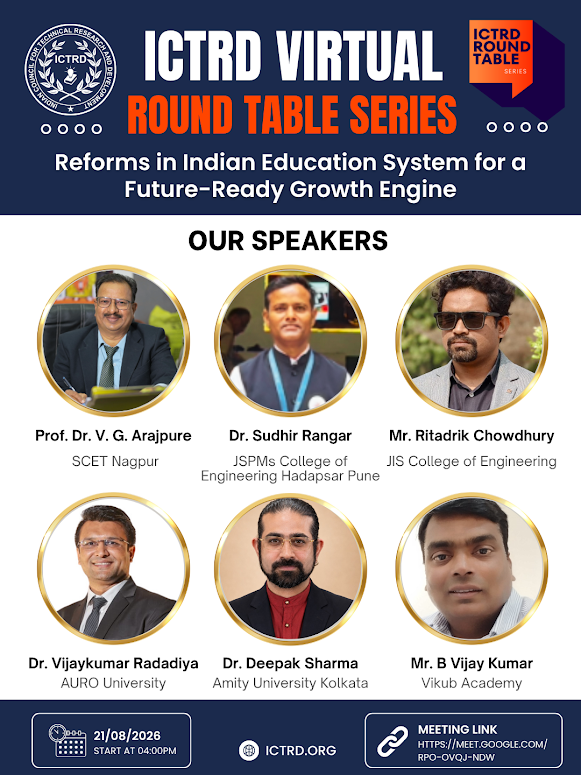
The Virtual Round Table organized by the Indian Council for Technical Research and Development (ICTRD) on 21st August 2026 brought together academicians, education leaders, industry experts, educators, and researchers to discuss a critical question for India’s future: How can India reform its education system to become a future-ready growth engine? At a time when artificial intelligence, automation, emerging technologies, and changing workforce requirements are reshaping the world, the discussion emphasized that Indian education must move beyond conventional degrees and examination-oriented learning to build skills, innovation, adaptability, and lifelong learning.
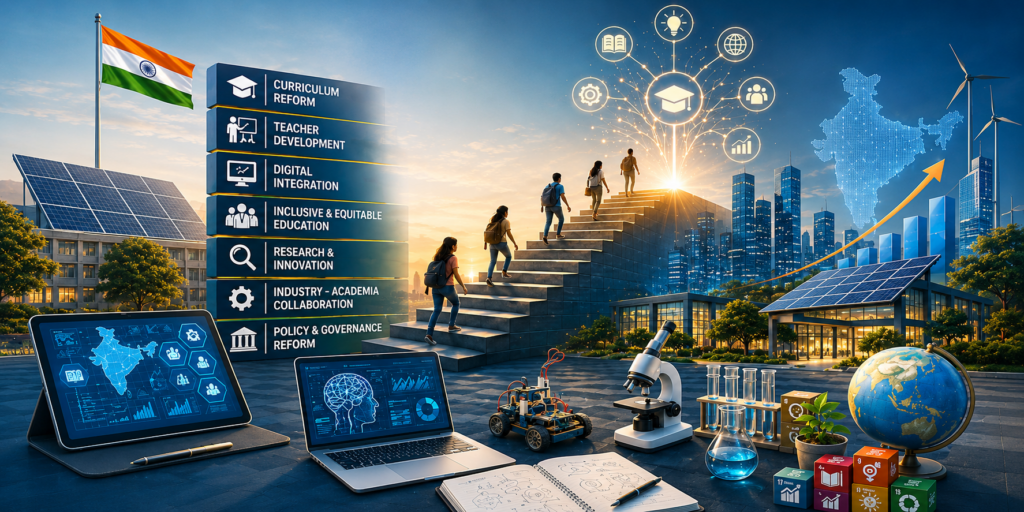
From Traditional Education to Future-Ready Learning
Opening the session, Mr. Siddharth Roy, Director of Communication, ICTRD, highlighted the scale of India’s education ecosystem and the need for it to evolve with the changing nature of work. He emphasized the growing importance of artificial intelligence, automation, emerging technologies, entrepreneurship, innovation, and lifelong learning in preparing students for the India and the world of tomorrow.
He also highlighted the close connection between education, research, and innovation, noting ICTRD’s efforts to bring academicians, industry leaders, researchers, and entrepreneurs together to discuss reforms that can strengthen India’s education ecosystem.
Building on this, Dr. Ashish Sasankar, Chairman, ICTRD, stressed that education must focus on developing capable, innovative, and future-ready individuals. He emphasized stronger industry-academia collaboration, practical learning, innovation, and value-based education, encouraging institutions to prepare students not only for employment but also to become problem-solvers and contributors to national development.
Dr. Ketan Mohitkar, Member Secretary, ICTRD, further emphasized that education reform is ultimately about the kind of India the country seeks to build over the next 25 years. He highlighted the shift from traditional degree-oriented education towards skill-based, modular, and practical learning in areas such as artificial intelligence, cybersecurity, data analytics, drone technology, EV technology, entrepreneurship, and digital marketing.
He also emphasized the need for credible frameworks for recognizing short-term and skill-based education, while maintaining quality standards and student protection. Degrees and skill-based education, he noted, should be viewed as complementary components of a flexible and future-ready education ecosystem.
Building a Skills-First Education Ecosystem
A key theme emerging from the discussion was the need to make skill development, multidisciplinary learning, and practical exposure integral to education.
Experts highlighted that students must be equipped not only with academic knowledge but also with the ability to apply that knowledge in real-world situations. Institutions were encouraged to strengthen industry partnerships, experiential learning, vocational education, entrepreneurship, and exposure to emerging technologies.
The discussion also emphasized that students should be able to move beyond the boundaries of their primary disciplines and develop complementary skills that reflect the increasingly interconnected nature of technology and industry.
Key Areas of Transformation
The Round Table identified several areas where Indian education can accelerate its transition towards a future-ready model:
● Skill-based learning aligned with emerging technologies and industry requirements.
● Multidisciplinary education that allows students to explore subjects beyond their core disciplines.
● Experiential learning and internships that connect academic knowledge with real-world applications.
● Industry-academia collaboration to strengthen employability, innovation, and practical exposure.
● Responsible use of Artificial Intelligence for learning, research, coding, creativity, and problem-solving.
● Teacher training and professional development to equip educators for changing learner needs.
● Digital and immersive learning through AI, AR, VR, XR, simulations, and interactive platforms.
● Inclusive digital education through regional languages, mobile-friendly platforms, low-bandwidth solutions, and
accessible learning technologies.
Collectively, these reforms can create a stronger bridge between education, employability, innovation, and India’s long-term economic growth.
Perspectives from Participating Experts
The discussion was enriched by insights from distinguished speakers representing engineering education, academia, skill development, and digital learning.
Prof. Dr. V. G. Arajpure, Principal, Suryodaya College of Engineering and Technology, Nagpur, emphasized the importance of NEP 2020 and its focus on skill development, innovation, entrepreneurship, internships, and vocational education. He highlighted emerging fields such as defence and ocean technology, space research, smart agriculture, drones, artificial intelligence, and industry-oriented technical skills.
He stressed that students should gain exposure to complementary areas such as automation and robotics, hydraulics and pneumatics, electronics, embedded systems, and 3D printing. He also highlighted the importance of Honours, Minors, additional credits, and flexible learning pathways. According to him, multidisciplinary and experiential learning will be essential for developing globally competitive professionals.
Mr. Ritadrik Chowdhury, Assistant Professor, JIS College of Engineering, West Bengal, focused on India’s young population and the need to convert its demographic advantage into meaningful human capital. He emphasized moving beyond rote learning and examination-oriented education towards creativity, questioning, problem-solving, interdisciplinary learning, and employability.
He highlighted the growing role of generative AI in education, stressing that tools such as ChatGPT, Claude, NotebookLM, and GitHub Copilot should be used as enablers of learning rather than shortcuts. Students must first develop strong fundamentals and then learn to use AI for research, coding, automation, critical evaluation, and creative problem-solving.
Mr. B. Vijay Kumar, Founder Director, Vikub Academy, Hyderabad, brought attention to the role of teachers as a central pillar of education reform. He emphasized that strengthening student capabilities must go hand in hand with strengthening teacher capabilities.
He highlighted challenges such as learning gaps, limited technology access, examination pressure, infrastructure differences, lack of career readiness, and difficulty in applying academic knowledge. He stressed the importance of continuous teacher training and professional development so educators can effectively integrate technology, address learner needs, and develop communication, creativity, problem-solving, teamwork, and career-readiness skills among students.
Dr. Deepak Sharma, Assistant Professor, Amity University Kolkata, focused on the future of digital and immersive education. He emphasized that simply digitizing existing teaching methods is not enough. Digital education must become more interactive, experiential, inclusive, and human-centred.
He highlighted the potential of gamification, simulations, AR, VR, XR, and immediate feedback to transform students from passive viewers into active participants. He also emphasized regional-language content, low-bandwidth solutions, mobile accessibility, reliable connectivity, and inclusive technologies.
Dr. Sharma further stressed that students must learn not only how to use AI but how to think critically with AI, combining technology with creativity, communication, problem-solving, and ethical decision-making. He also highlighted continuous teacher training and the future potential of immersive classrooms powered by XR and smart educational devices.
Challenges on the Path Ahead
While the opportunities are significant, the discussion also highlighted several challenges:
● Unequal access to technology and digital infrastructure
● Gaps between academic curricula and industry
requirements.
● Limited opportunities for experiential and practical
learning.
● Inadequate teacher training and professional
development.
● Regulatory and institutional barriers for specialized
skill-based education.
● Limited exposure to emerging technologies.
● Risk of excessive dependence on AI without strong
foundational knowledge.
● Digital connectivity and accessibility challenges
across different regions.
Participants agreed that addressing these challenges will require coordinated efforts from government, educational institutions, industries, teachers, researchers, and technology providers.
ICTRD and the Role of Collaborative Platforms
The Indian Council for Technical Research and Development (ICTRD) continues to play an important role in creating platforms for dialogue among academia, industry, researchers, educators, and other stakeholders.
Through initiatives such as the Virtual Round Table series, ICTRD facilitates the exchange of ideas and encourages practical discussions around education, research, innovation, technology, and national development.
Such collaborative platforms are essential for moving the conversation from identifying challenges to developing practical, scalable, and implementable reforms.
Conclusion
The Round Table concluded with a shared understanding that India’s future growth will depend significantly on the strength and adaptability of its education system. The country must move from degrees to capabilities, from rote learning to critical thinking, from passive education to experiential learning, and from isolated disciplines to multidisciplinary collaboration.
A future-ready education system must develop not only graduates, but skilled professionals, innovators, entrepreneurs, problem-solvers, critical thinkers, and lifelong learners.
Through effective implementation of NEP 2020, stronger industry partnerships, skill-based education, empowered teachers, responsible AI adoption, immersive learning, and inclusive digital infrastructure, India can transform its education ecosystem into a powerful growth engine.
The reform of Indian education is ultimately not just about preparing students for the jobs of today. It is about building the capabilities, mindset, and innovation potential required for the India of tomorrow and the vision of Viksit Bharat 2047.